
2025 has been the year Bruno became mainstream and cemented its place as a daily driver for developers.
We shipped 78 releases, completed the v1 to v2 transition, and doubled down on what makes Bruno different: fast, local-first, and Git-native API Client that cares about the developer community.
We're honored to have the opportunity of building a product alongside millions of passionate developers and appreciate every request you send through Bruno.
Growing Strong: Company Milestones
2025 was a turning point for Bruno.
We grew from 6 to 23 people globally across engineering, design, product, and GTM. That growth allowed us to ship faster, respond to feedback more quickly, and take on larger improvements without losing the focus that made Bruno what it is.
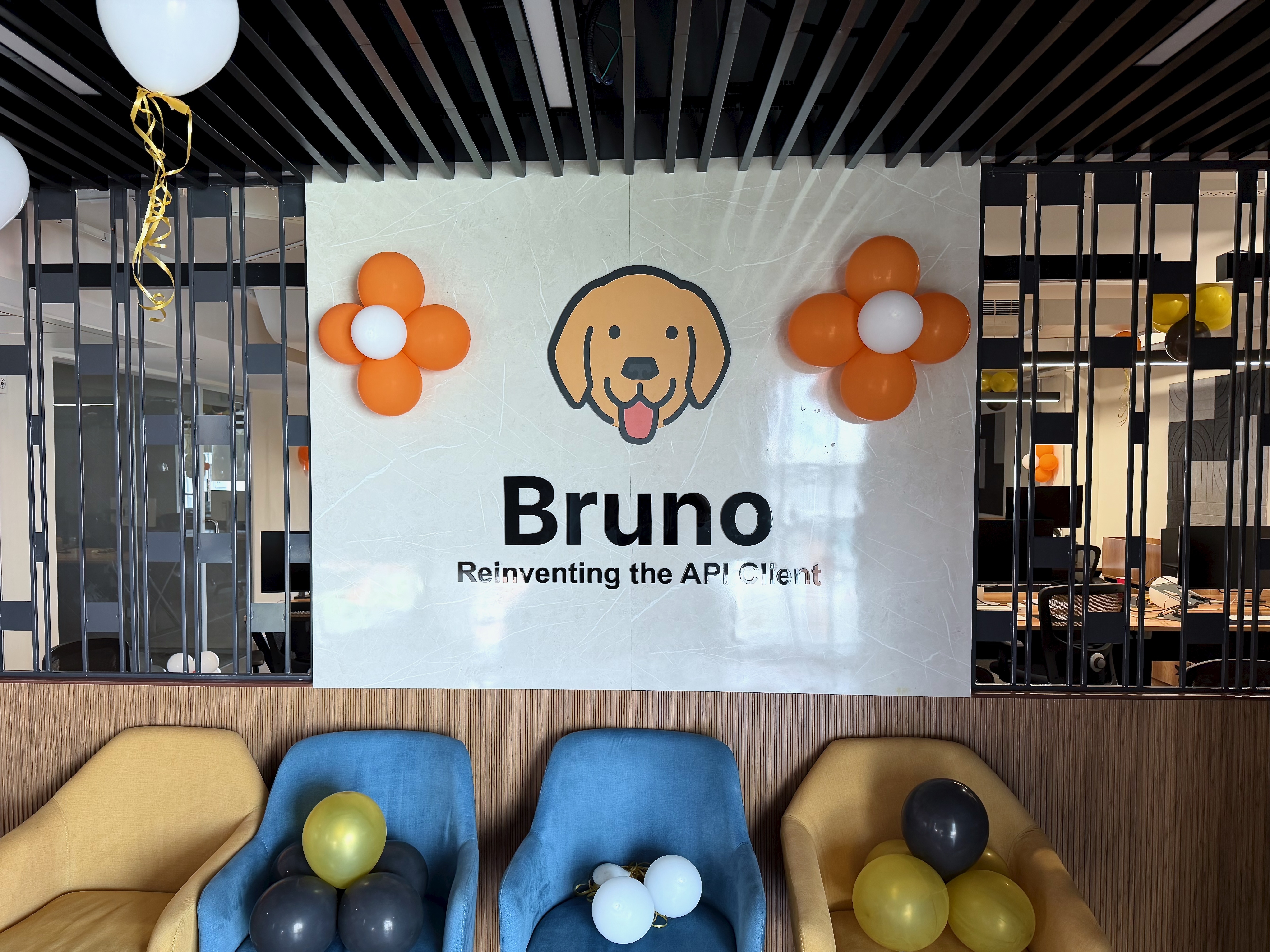
We also opened a new headquarters in Bangalore, giving the team a shared space to collaborate day to day. Bruno has always been global, but having a fresh home base has noticeably improved how we plan, build, and ship together.
 |
 |
By the Numbers: Shipping Every Week
A snapshot of what we shipped in 2025:
- 312+ new features (roughly one every 28 hours)
- 387+ bug fixes (that’s ~7.5 fixes per week, all year)
- 78 releases (more releases than the number of keys on a piano, and way more useful)
- Major version leap, moving from v1.38.0 to v2.15.1, including the full v1 to v2 transition
That pace was intentional. The goal wasn't just to ship for the sake of speed to volume; the aim with each release was to steadily remove friction and make Bruno feel better with every update.
We've highlighted a number of features below, but a few of the areas we had (and continue to have) focus on for incremental continuous improvements were: onboarding/migration from Postman, working with different authentication methods, and advancing the capabilities of our CLI for automation.
Adoption: Going Mainstream
Shipping is only half the story. The other half is how many developers showed up and stuck around.
- Monthly active users grew from ~250k in January 2025 to 600k+ by December 2025
- At our peak, we saw 250k new users in a single month
- GitHub stars grew from 26k to 40k
That kind of adoption only happens when a tool fits into real workflows. Git-native, offline-first, and fast still resonates.
Features We’re Most Proud Of
OAuth 2.0 Revamp (v2.0.0)
In March, we rebuilt OAuth 2.0 based directly on community feedback. We removed the need for separate authorization and resource requests, added automatic token injection, and made OAuth feel like a natural part of the request workflow instead of a separate setup step.
WebSocket Client Support (v2.13.0)
We added WebSocket support with the same principles as the rest of Bruno. Local-first, Git-friendly, and reviewable in a pull request. Real-time API testing should not require a different tool or a hosted dashboard.
gRPC Graduated to GA (v2.13.0)
After months in beta, gRPC became generally available with server reflection, import paths, and smoother integration with existing collections. Teams working across REST and gRPC can now keep everything in one place.
Bruno Ultimate Trials (v2.15.0)
We launched 14-day trials of our commercial product. This marked an important step toward building a sustainable business while keeping Bruno open-source and developer-first. This lets us invest more into the product without changing what Bruno stands for.
Request and Response Examples (v2.14.0)
We added native support for request and response examples so API collections can double as living documentation. This reduces duplication and makes collections easier to understand for new team members.
Dev Tools Integration (v2.8.0)
We brought browser-style debugging into Bruno with network logs, request metadata, and response analysis. When something breaks in an API flow, you should be able to see exactly why.
Collection Runner Improvements
Throughout the year, we invested heavily in the collection runner. Parallel execution, CSV iterations, test filtering, and a redesigned UI all landed in 2025. It is one of the most used parts of Bruno, and we treated it as a core product, not an afterthought.
Postman Migration and Translation
We realize that nearly all of you are coming from different tools, and Postman is the most common. We spent a lot of time in 2025 working on making the process smoother to simply import your collections and get on with your work in Bruno. This won't stop in 2026 and the end goal is for it to be as automatic/"automagic" :) as possible.
The Philosophy Behind the Work
Bruno continues to be shaped by a few core beliefs:
- API collections should live in your repository, next to your code
- Your tooling should feel fast, not heavy
- Developers should stay in control of their data and workflows
Every feature we shipped this year ties back to these ideas.
Looking Forward
2025 strengthened our conviction in what we believed going in. Developers want simpler, faster, more transparent API tooling.
We shipped 78 releases, grew the team, and Bruno is now used by hundreds of thousands of developers. The foundation is strong, and the direction is clear.
We’re closing the year with v2.15.1, and we’re already gearing up for our v3 release on January 5th, 2026.
You can try our v3 early preview today that includes major new capabilities that change how people structure and use Bruno: workspaces for multi-project workflows, native YAML support alongside Bru, and an inbuilt terminal for running CLI tasks without leaving the app. These features are part of a broader push to make Bruno feel more like a complete development environment while staying fast, local, and Git-centric.
Ever since the inception of the product 4 years ago frequent shipping let us iterate fast, fix issues quickly, and build Bruno around real usage. That pace got us here. In 2026, we’re moving to a predictable monthly release cadence with a stronger focus on stability.
For those who want early access—and are comfortable living a little closer to the edge—nightly builds will continue.
2026, here we come.
Happy New Year from the Bruno team!