Bruno Wins API World 2026 Award for Best in API Developer Experience

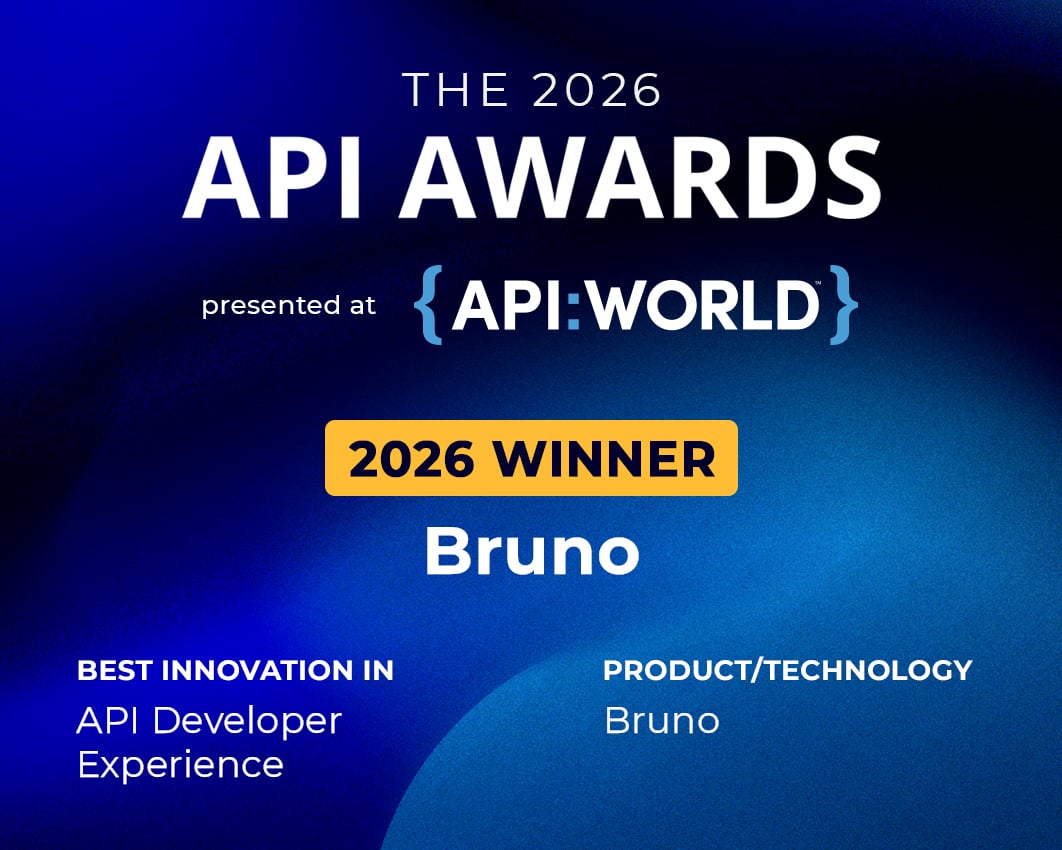
Bruno Wins API World 2026 Award for Best in API Developer Experience
We’re excited to share that Bruno has been named the winner of the API World 2026 Award for Best in API Developer Experience.
We’re incredibly grateful to the API World judges and to the millions of developers who have helped shape Bruno into what it is today.
While we’re honored by the recognition, we believe the award reflects something much bigger than Bruno itself. It reflects a shift in how developers want to build with APIs.
API development has changed
For years, API clients have largely been built around the idea that your work lives in the cloud.
That made collaboration possible, but it also introduced tradeoffs. Teams had to create accounts, synchronize workspaces, manage permissions, and trust a third party with API definitions, environments, and requests.
Bruno started with a simple question:
What if your API collections were just files?
That single decision fundamentally changed how an API client could work.
Local-first by design
Every Bruno collection lives on your machine as plain-text files.
No cloud account is required. No forced synchronization. No vendor-controlled workspace.
Your APIs remain under your control, whether you’re building personal projects, enterprise software, or working in highly regulated environments.
For many organizations, especially those in finance, healthcare, government, and critical infrastructure, this isn’t just a preference. It’s a requirement that is enforced internally as well as by external regulators.
Local-first architecture gives developers the confidence that their API assets stay exactly where they choose.
Git becomes the collaboration platform
Because Bruno stores collections as files instead of proprietary cloud objects, they’re versioned exactly like source code.
Developers can:
- Commit API changes alongside application code
- Review changes through pull requests
- Branch and merge API work
- Audit every modification over time
- Use existing Git workflows without learning a separate collaboration model
Instead of introducing another collaboration platform, Bruno embraces the one development teams already use every day.
APIs become part of the software development lifecycle rather than living outside of it.
Built for the age of AI
When we first built Bruno’s file-based architecture, AI coding agents didn’t exist.
Today, that design decision has become even more important.
Modern coding agents don’t navigate proprietary cloud databases. They understand files.
Because Bruno collections are simply text files stored alongside your codebase, AI assistants and autonomous coding agents can naturally:
- Read existing API collections
- Generate new requests
- Update authentication flows
- Create tests
- Refactor collections
- Execute API workflows as part of development
There’s no special integration required.
If an AI agent can work with your repository, it can work with Bruno.
As software development becomes increasingly AI-assisted, we believe this model becomes the natural way to build and test APIs.
This is only the beginning
From the beginning, Bruno has been driven by a simple philosophy:
Developers should own their API workflows.
That means keeping data local, embracing open standards, integrating with Git instead of replacing it, and making API collections accessible to both humans and machines.
Winning API World’s Best in API Developer Experience award is an incredible milestone, but it’s also validation that these principles matter.
To everyone who has contributed code, reported bugs, requested features, shared Bruno with colleagues, or simply chose to make it part of your workflow... thank you!
We’re excited for what’s next.
The future of API development is local-first, Git-native, and AI-native.